Platform comparison
| Platform | YES odds | NO odds | Fee | KYC | Settlement | |
|---|---|---|---|---|---|---|
Polymarket (via Polymarket Alternative) Pick polygram.ink (preferred broker) |
32% | 68% | 0% (USDC on-chain) | No-KYC up to $1,500 | USDC, auto via UMA oracle | Open the market → |
Polymarket (direct) polymarket.com |
32% | 68% | 0% | Geo-blocked in US/UK/EU | USDC, on-chain | Open the market → |
Kalshi kalshi.com |
— | — | Up to 7% per trade | US-only, KYC required | USD | Open the market → |
Betfair Exchange betfair.com |
— | — | 2-5% commission | Full KYC from first trade | GBP / EUR | Open the market → |
Manifold Markets manifold.markets |
— | — | Play-money (mana) | None — play-money | Mana (no cash-out) | Open the market → |
Outcome probabilities
Current market-implied probability for each outcome, from the live order book.
| Outcome | Probability |
|---|---|
| August 31 | 32% |
| July 31 | 23% |
| July 15 | 11% |
| June 30 | 0% |
Market context
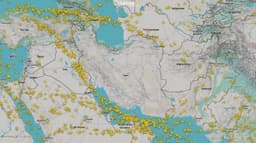
Iran’s airspace remains partially open but heavily restricted following the February 2026 US–Israel strikes and Tehran’s retaliation, which triggered a near-total shutdown across the Middle East. At that peak, Iran declared a general closure of its Tehran FIR, joining eight other nations in suspending commercial overflights [1][2]. By June 2026, the eastern sector of the FIR reopened for limited overflights, yet most international operators still avoid Iranian skies, routing Europe–Asia traffic via Egypt, Saudi Arabia, or the Caucasus [4]. This pattern of partial reopening without full normalisation frames the current 0% crowd-implied probability: a general closure has occurred, but it was temporary and conflict-driven, not a sustained policy shift.
Traders should monitor official NOTAMs from Iran’s Civil Aviation Organisation and FAA advisories, particularly any extension of the current US prohibition on operations in the Tehran FIR, which runs until October 2027 [4]. Key catalysts include renewed military escalations, diplomatic announcements on de-escalation, and scheduled airline route reviews. Reuters reported in January 2026 that the EU agency warned airlines to avoid Iranian airspace amid continued military risk, while Lufthansa suspended use of Iranian and Iraqi airspace indefinitely [8]. Any new closure announcement would likely trigger immediate flight cancellations and regional rerouting, as seen in February 2026 when 24% of Middle East flights were cancelled [1].
Platform comparisons matter here: Polymarket displays 0% implied probability, whereas Kalshi, Betfair, and Smarkets would show decimal odds of 1.00 (or “no price” if liquidity is absent). Fee structures diverge sharply—Polymarket charges 0–2% per trade depending on volume, while Kalshi imposes a 1% fee on winnings and Betfair/Smarkets charge 2–5% on net profits. KYC reach also differs: Polymarket allows non-KYC crypto access, whereas Kalshi requires full US identity verification, and Betfair/Smarkets enforce EU/UK KYC. These structural gaps affect how quickly probability shifts translate into tradable odds across books.
Methodology
We read Iran full airspace closure by 2026? from four platform perspectives: Polymarket (on-chain CLOB), Kalshi (CFTC-regulated exchange), Betfair Exchange (sports book exchange), Smarkets (peer-to-peer betting exchange). Polymarket's live mid is the canonical probability; the side-by-side columns benchmark fees, KYC, settlement currency and deposit rails so you can choose the venue that fits your jurisdiction and trade size.
Resolution & payout
Polymarket settles via UMA Optimistic Oracle on Polygon. A proposer posts the outcome with a bond, the two-hour window runs, then the smart contract pays USDC.
Kalshi settles USD through the CFTC-regulated clearinghouse — the cleanest variant, with heavier KYC. Betfair Exchange settles in account currency (GBP/EUR), net of 2-5% commission. Smarkets follows the same model as Betfair with a lower default 2% commission.
FAQ
- Polymarket vs Kalshi — which is better?
- Depends on your location. Kalshi is CFTC-regulated, US-only with full KYC. Polymarket is global, on-chain, no KYC up to $1,500. Polymarket has ~10x higher liquidity but higher regulatory risk.
- What does Polymarket cost vs Kalshi?
- Polymarket: 0% fees, only Polygon network costs (~$0.01/trade). Kalshi: up to 7% per trade plus spread. For high-frequency traders, Polymarket is dramatically cheaper.
- What about Smarkets as an alternative?
- Smarkets is a UK betting exchange with a lower default commission (2%) than Betfair. Liquidity on political markets is below Polymarket, comparable to Kalshi. Geo-blocked in many jurisdictions.
- Are all these platforms regulated?
- No. Kalshi is CFTC-regulated (US). Betfair and Smarkets are UK Gambling Commission licensed. Polymarket operates without explicit regulation — a different risk profile than a regulated sportsbook.
- Which platform supports Klarna/SOFORT?
- Directly: none. Polymarket accepts only USDC on Polygon. Polymarket Alternative offers a fiat on-ramp via Klarna or SOFORT (DE/AT/CH) and converts internally to USDC for the Polymarket order book. T+1 processing.
%22%2F%3E%3Cpath%20d%3D%22M%206%2066%20A%2026%2026%200%200%201%2058%2066%22%20fill%3D%22%23E6B98D%22%20opacity%3D%220.9%22%2F%3E%3Ccircle%20cx%3D%2232%22%20cy%3D%2226%22%20r%3D%2222%22%20fill%3D%22%23F5CBA7%22%2F%3E%3Crect%20x%3D%2210%22%20y%3D%224%22%20width%3D%2244%22%20height%3D%2214%22%20rx%3D%227%22%20fill%3D%22%2314b8a6%22%20opacity%3D%220.9%22%2F%3E%3Crect%20x%3D%228%22%20%20y%3D%2218%22%20width%3D%228%22%20%20height%3D%2218%22%20rx%3D%224%22%20fill%3D%22%2314b8a6%22%20opacity%3D%220.7%22%2F%3E%3Crect%20x%3D%2248%22%20y%3D%2218%22%20width%3D%228%22%20%20height%3D%2218%22%20rx%3D%224%22%20fill%3D%22%2314b8a6%22%20opacity%3D%220.7%22%2F%3E%3C%2Fsvg%3E) and
and%22%2F%3E%3Cpath%20d%3D%22M%206%2066%20A%2026%2026%200%200%201%2058%2066%22%20fill%3D%22%23E6B98D%22%20opacity%3D%220.9%22%2F%3E%3Ccircle%20cx%3D%2232%22%20cy%3D%2226%22%20r%3D%2222%22%20fill%3D%22%23F5CBA7%22%2F%3E%3Cpath%20d%3D%22M%2010%2026%20A%2022%2028%200%200%201%2054%2026%22%20fill%3D%22%2314b8a6%22%20opacity%3D%220.9%22%2F%3E%3C%2Fsvg%3E)
Trade Iran full airspace closure by 2026? on Polymarket Alternative
Live order book, 0% fees, USDC settlement in seconds.
Open live market →