Platform comparison
| Platform | YES odds | NO odds | Fee | KYC | Settlement | |
|---|---|---|---|---|---|---|
Polymarket (via Polymarket Alternative) Pick polygram.ink (preferred broker) |
25% | 75% | 0% (USDC on-chain) | No-KYC up to $1,500 | USDC, auto via UMA oracle | Open the market → |
Polymarket (direct) polymarket.com |
25% | 75% | 0% | Geo-blocked in US/UK/EU | USDC, on-chain | Open the market → |
Kalshi kalshi.com |
— | — | Up to 7% per trade | US-only, KYC required | USD | Open the market → |
Betfair Exchange betfair.com |
— | — | 2-5% commission | Full KYC from first trade | GBP / EUR | Open the market → |
Manifold Markets manifold.markets |
— | — | Play-money (mana) | None — play-money | Mana (no cash-out) | Open the market → |
Outcome probabilities
Current market-implied probability for each outcome, from the live order book.
| Outcome | Probability |
|---|---|
| Somaliland | 25% |
| Qatar | 12% |
| Jordan | 12% |
| Syria | 12% |
| Turkey | 10% |
| Kuwait | 10% |
| Lebanon | 10% |
| Saudi Arabia | 9% |
| Egypt | 8% |
| Azerbaijan | 7% |
| Pakistan | 6% |
| Oman | 5% |
Market context
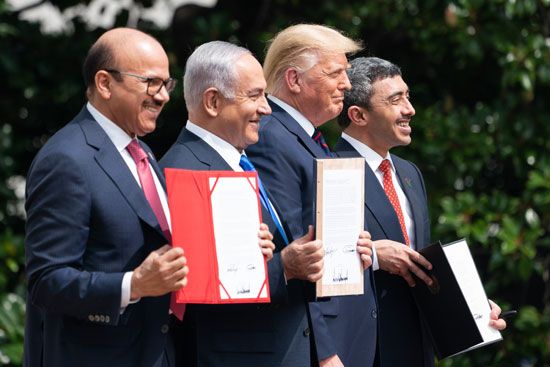
The live question is whether another state will formally normalise relations with Israel under the Abraham Accords framework before the 31 December 2026 deadline. The market is pricing this at only 6% YES, which is consistent with the fact that the pact has only a small set of existing members and that new accessions have been infrequent; recent reporting also suggests the next entrant may already be in motion, with Kazakhstan publicly announced by the White House as joining the Accords, which would matter if the signing lands inside the market window.[3][5]
That low probability sits against a recent precedent that traders can benchmark directly: the Accords have expanded beyond the original 2020 signatories, but each addition has required explicit government confirmation rather than vague diplomatic contact.[3][4] On Polymarket, the market is quoted as an implied probability; on Kalshi, the same event would typically be framed through exchange-style prices and fees, while Betfair and Smarkets usually display decimal odds and apply their own commission structures, so the same underlying view can look slightly different after costs. The main liquidity question is not whether interest exists, but whether a named government will move from signalling to an official, attributable signing before year-end.[1][2]
The catalysts to watch are formal White House, foreign ministry, or Israeli government statements, plus any scheduled bilateral meetings that could turn into a signing ceremony, because the resolution rule depends on public acknowledgement and clear attribution to the Abraham Accords or its continuation.[2] For a trader, the key dependency is whether reported talks convert into an actual agreement rather than just diplomatic rhetoric: if a country is mentioned in press coverage but no formal announcement follows, the market still resolves No. On a platform-comparison basis, that means Polymarket traders are likely to react fastest to headline momentum, while Kalshi, Betfair, and Smarkets users may care more about fee-adjusted entry points and whether their jurisdictional KYC access even allows participation.
Methodology
We read Which country will join Abraham Accords before 2027? from four platform perspectives: Polymarket (on-chain CLOB), Kalshi (CFTC-regulated exchange), Betfair Exchange (sports book exchange), Smarkets (peer-to-peer betting exchange). Polymarket's live mid is the canonical probability; the side-by-side columns benchmark fees, KYC, settlement currency and deposit rails so you can choose the venue that fits your jurisdiction and trade size.
Resolution & payout
Polymarket settles via UMA Optimistic Oracle on Polygon. A proposer posts the outcome with a bond, the two-hour window runs, then the smart contract pays USDC.
Kalshi settles USD through the CFTC-regulated clearinghouse — the cleanest variant, with heavier KYC. Betfair Exchange settles in account currency (GBP/EUR), net of 2-5% commission. Smarkets follows the same model as Betfair with a lower default 2% commission.
FAQ
- Polymarket vs Kalshi — which is better?
- Depends on your location. Kalshi is CFTC-regulated, US-only with full KYC. Polymarket is global, on-chain, no KYC up to $1,500. Polymarket has ~10x higher liquidity but higher regulatory risk.
- What does Polymarket cost vs Kalshi?
- Polymarket: 0% fees, only Polygon network costs (~$0.01/trade). Kalshi: up to 7% per trade plus spread. For high-frequency traders, Polymarket is dramatically cheaper.
- What about Smarkets as an alternative?
- Smarkets is a UK betting exchange with a lower default commission (2%) than Betfair. Liquidity on political markets is below Polymarket, comparable to Kalshi. Geo-blocked in many jurisdictions.
- Which platform is accessible globally?
- Polymarket is geo-blocked in the US/UK/EU. Kalshi is US-only. Betfair and Smarkets are UK-restricted. Polymarket Alternative has a different geo footprint and routes to Polymarket's order book at 0% fees.
- Which platform supports Klarna/SOFORT?
- Directly: none. Polymarket accepts only USDC on Polygon. Polymarket Alternative offers a fiat on-ramp via Klarna or SOFORT (DE/AT/CH) and converts internally to USDC for the Polymarket order book. T+1 processing.
%22%2F%3E%3Cpath%20d%3D%22M%206%2066%20A%2026%2026%200%200%201%2058%2066%22%20fill%3D%22%23E6B98D%22%20opacity%3D%220.9%22%2F%3E%3Ccircle%20cx%3D%2232%22%20cy%3D%2226%22%20r%3D%2222%22%20fill%3D%22%23F5CBA7%22%2F%3E%3Crect%20x%3D%2210%22%20y%3D%224%22%20width%3D%2244%22%20height%3D%2214%22%20rx%3D%227%22%20fill%3D%22%2314b8a6%22%20opacity%3D%220.9%22%2F%3E%3Crect%20x%3D%228%22%20%20y%3D%2218%22%20width%3D%228%22%20%20height%3D%2218%22%20rx%3D%224%22%20fill%3D%22%2314b8a6%22%20opacity%3D%220.7%22%2F%3E%3Crect%20x%3D%2248%22%20y%3D%2218%22%20width%3D%228%22%20%20height%3D%2218%22%20rx%3D%224%22%20fill%3D%22%2314b8a6%22%20opacity%3D%220.7%22%2F%3E%3C%2Fsvg%3E) and
and%22%2F%3E%3Cpath%20d%3D%22M%206%2066%20A%2026%2026%200%200%201%2058%2066%22%20fill%3D%22%23E6B98D%22%20opacity%3D%220.9%22%2F%3E%3Ccircle%20cx%3D%2232%22%20cy%3D%2226%22%20r%3D%2222%22%20fill%3D%22%23F5CBA7%22%2F%3E%3Cpath%20d%3D%22M%2010%2026%20A%2022%2028%200%200%201%2054%2026%22%20fill%3D%22%2314b8a6%22%20opacity%3D%220.9%22%2F%3E%3C%2Fsvg%3E)
Trade Which country will join Abraham Accords before 2027? on Polymarket Alternative
Live order book, 0% fees, USDC settlement in seconds.
Open live market →